You know the cut you want. You’ve seen it on someone else’s Instagram, or you got it once by accident and have been chasing it ever since. The haircut isn’t the hard part. The conversation is.
You sit down, the cape goes on, and the barber asks the question that trips up almost every new client: “What are we doing today?” Say “just a fade” and you’re rolling the dice on what comes out. Say the right three things, in the right order, and your barber can build the exact cut in your head without a single guess.
This guide breaks down how to ask for a skin fade the way a working barber actually listens for it, plus the terms, the phrasing, and the small mistakes that turn a great haircut into an okay one.
First, the three dials your barber is listening for

Every skin fade, and honestly every fade of any kind, comes down to three decisions. Cover these three and your barber has everything they need.
1. Where does the fade start?
This is the height on the side of your head where the clippers begin the gradient. There are three common starting points.
- Low fade. The blend starts just above the ear. It’s subtle, and most people read it as a clean, sharp haircut rather than a “fade.”
- Mid fade. The blend starts around the temple, roughly halfway between the ear and the crown. This is the most requested version, and the one most barbers default to if you don’t specify.
- High fade. The blend starts up near the crown. It’s bold, high contrast, and leaves a lot of shorter hair visible under whatever you’re wearing on top.
You don’t need a diagram for this. Say it in three words: “low skin fade,” “mid skin fade,” or “high skin fade,” and your barber already knows where the clippers start.
2. How short does it go at the bottom?
This is the part that actually makes it a skin fade instead of a regular fade. “Skin fade” means the shortest point is bare skin, no guard at all. If you don’t want to see scalp, you don’t want a skin fade. You want a low fade or a taper instead, and it’s worth saying that out loud, because mixing these two up is the single most common miscommunication in a barber’s chair.
If you like the look of near bare skin but want a hair’s width of coverage left, ask for a “zero grade” or tell your barber you want it “balded out to a zero, not fully skin.” Barbers use these terms constantly and will know exactly what you mean.
3. How does the fade connect to the top?
This is the detail almost everyone forgets to mention. The fade only describes the sides and back. You still need to tell your barber what’s happening on top, and how the two are supposed to meet.
- “Scissor finish on top.” The top is cut with shears rather than clippers, which keeps more natural texture and movement.
- “Blended in.” You want a smooth, gradual transition from the fade into the length on top, with no visible line.
- “Hard line” or “disconnected.” You want a visible, sharp line where the shaved sides stop and the longer top begins. This reads sharper and more graphic, closer to an undercut.
Where, how short, and what’s on top. Nail those three dials and you’ve already communicated more clearly than most walk-ins ever do.
The phrasebook: what to actually say

Here’s a fill in the blank template you can use as is.
“Can I get a [low / mid / high] skin fade, with a [scissor finish / blended / hard line] top, and leave about [length] on top?”
That single sentence covers all three dials. Below are three ready to use versions, from simple to specific.
The one-sentence skin fade
“Mid skin fade, blended into a scissor finish, leave about two inches on top.”
This is enough for most barbers to work confidently without any follow up questions.
The more specific version
“High skin fade, start the fade at the temple, blend into a scissor finish on top. Keep about two and a half inches on top with natural texture, no slicked down or pomade look.”
Use this version if you’ve had a fade go wrong before, or if you’re seeing a new barber for the first time and want to close every gap.
When you want to show a photo
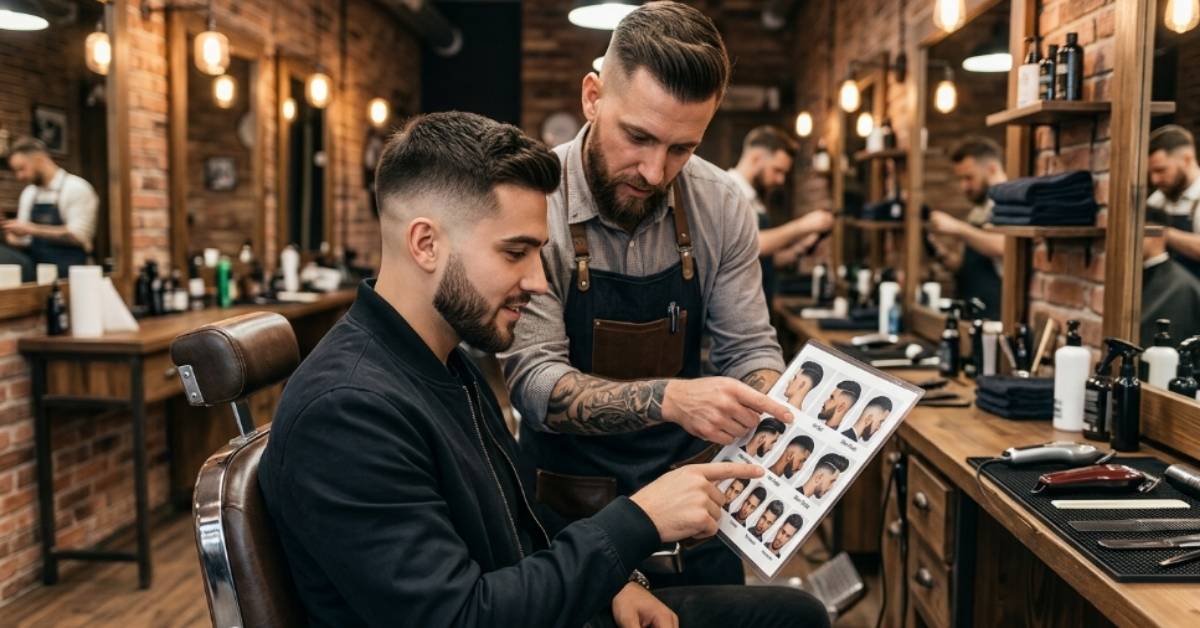
“I like the fade height and contrast in this photo. Can we match that part of it? On top, I’d like a little more length than the picture shows.”
A photo plus a sentence explaining what you’d change is far more useful than a photo alone. It tells the barber exactly which parts of the reference to copy and which to adjust for your hair and face shape.
Barber terms you’ll hear (and what they actually mean)

A few words tend to come up in almost every skin fade consultation. Knowing them removes the guesswork on both sides of the chair.
- Guard number. The plastic attachment on the clippers that controls length. A 0 is skin, a 1 is roughly one eighth of an inch, a 2 is about a quarter inch, and a 3 is closer to three eighths. A skin fade always bottoms out at 0, no guard.
- Fade line. The horizontal point on your head where the fade visually begins. A “higher fade line” means the gradient starts further up toward the crown.
- Drop fade. The fade line curves downward behind the ear, following the shape of the skull toward the nape rather than staying level. It reads as a bit more stylized than a standard fade.
- Burst fade. The fade fans out around the ear like sun rays instead of running in a straight line, usually paired with a longer, textured top.
- Scissor work. Cutting the top with shears rather than clippers, which tends to look softer and more natural.
- Blend. The invisible gradient between two different lengths of hair, with no hard edge.
- Taper. Often confused with a fade, but different. A taper keeps visible length through the sides and only tightens up around the ears and neckline; it doesn’t necessarily reach skin. If you want something less dramatic than a full fade, this is usually the word you’re looking for.
- Hard part. A thin line shaved directly into the hair to create a defined, permanent looking part. Most shops treat this as a quick, often free add-on.
- Neckline. The shape of the hairline at the back of the neck. The three standard options are square (sharp corners), rounded (soft corners), and natural (the barber cleans up your actual hairline rather than reshaping it). For a skin fade, natural or rounded tends to hold its shape better between visits.
Three things we wish every first-timer knew

A skin fade grows out in ten days, not thirty
The bare skin at the bottom of a fade is the sharpest thing about the cut on day one, and it’s the first part to soften. By day fourteen the contrast has faded noticeably, and by day twenty one it usually reads more like a soft mid fade than a skin fade. If your schedule only allows a haircut every four to six weeks, a skin fade will spend most of that stretch looking grown out rather than crisp. A low fade or a taper holds its shape much longer on a monthly cadence, so match the cut to how often you can realistically get back in the chair.
“Number 1 all over” isn’t a skin fade
This mix up happens constantly. A “1 all over” is a buzz cut, meaning the same length across the entire head with no gradient at all. A skin fade is a gradient, running from bare skin at the bottom up to a longer length on top. If you’ve been asking for “a number one” at a quick clip shop and expecting a fade, that’s why the result hasn’t matched what you pictured.
The top matters as much as the fade
A technically flawless fade attached to a forgettable top still looks like an average haircut. The top is where a barber’s scissor skill actually shows up, and it’s also the part that changes how the whole cut reads day to day. Spend as much time describing the top (length, texture, part, how much product you use) as you do describing the fade itself.
What to ask about the top

Use this short checklist. One answer per line is all it takes.
- Length. “About an inch,” “two inches,” “finger length,” or “keep most of what’s already there.”
- Texture. “Cut smooth and tight” for a cleaner, more formal look, or “leave in some texture, don’t blunt it off” for something more casual with movement.
- Part. “I part it on the left,” “I wear it pushed straight back,” or “I don’t part it at all.”
- Styling product. “I use pomade,” “I use a matte paste,” or “I don’t use anything.” This tells your barber how the hair will actually sit day to day, which changes how they cut it.
What to do if the cut isn’t quite right

Say something while you’re still in the chair. A quick adjustment mid cut takes two minutes with the clippers; living with a cut you don’t love takes two weeks. Specific feedback gets the fastest fix. Try phrases like “can we take the fade a little higher?” or “can we leave a bit more length on top?” or “can the neckline be a touch rounder?” A good barber wants that feedback, not a silent client who leaves unhappy.
If something bothers you once you’re home and looking at it in better light, most barbershops will do a quick, no charge tidy up within the first week if you call and explain. That’s a normal, expected part of the service, not an imposition.
How to book a skin fade at The Kinsman

At The Kinsman, every fade variant, including the skin fade, falls under one menu item: Skin Fade, priced at $70. Booking that service gets you a full thirty minute appointment with a barber who will walk through the same three dials covered above before the clippers ever come out. If you decide you’d rather have a taper once you’re in the chair, that’s fine too; it’s the same service, just a different setting on the clippers.
You can book a skin fade online or walk in during business hours. If it’s your first time at a traditional barbershop, it’s worth reading through what to expect on your first visit beforehand, since it covers payment, how the chair rotation works, and what else is worth adding to the appointment.
Still deciding between a taper, a mid fade, and a full skin fade? The Taper Fade vs. Skin Fade vs. Mid Fade guide breaks down the differences side by side with a simple decision tree.
Frequently asked questions
What’s the difference between a skin fade and a bald fade?
Nothing meaningful. They’re the same haircut under two different names, and some shops also call it a “zero fade.” Use whichever term you like; any barber will understand you.
Can I ask for a skin fade if my hair is thinning?
Often yes, but it depends on where the thinning is. Thinning on top actually pairs well with a skin fade, since the shaved sides pull attention downward and away from it. Thinning on the sides or temples is a different story, since a skin fade will expose more scalp in exactly that spot. Tell your barber where you’re thinning and ask for an honest opinion; a low fade or taper is sometimes the better call.
How often should I book a skin fade touch-up?
Every two to three weeks keeps the contrast looking close to day one. Most people settle into a three to four week rhythm and touch it up before it fully softens. Past the four week mark, most of the sharp contrast is gone. A standing appointment every three weeks with the same barber is the easiest way to keep it consistent without having to think about it.
Is it rude to bring a photo to a barber?
Not at all, it’s usually the fastest way to get on the same page. The only real rule is to bring a photo of an actual haircut on a real person rather than a heavily edited or AI-generated image, and to stay realistic that the final cut needs to work with your own hair type and head shape, not the model’s.
You sit down, the cape goes on, and the barber asks the question that trips up almost every new client: “What are we doing today?” Say “just a fade” and you’re rolling the dice on what comes out. Say the right three things, in the right order, and your barber can build the exact cut in your head without a single guess.
This guide breaks down how to ask for a skin fade the way a working barber actually listens for it, plus the terms, the phrasing, and the small mistakes that turn a great haircut into an okay one.
First, the three dials your barber is listening for
Every skin fade, and honestly every fade of any kind, comes down to three decisions. Cover these three and your barber has everything they need.
1. Where does the fade start?
This is the height on the side of your head where the clippers begin the gradient. There are three common starting points.
- Low fade. The blend starts just above the ear. It’s subtle, and most people read it as a clean, sharp haircut rather than a “fade.”
- Mid fade. The blend starts around the temple, roughly halfway between the ear and the crown. This is the most requested version, and the one most barbers default to if you don’t specify.
- High fade. The blend starts up near the crown. It’s bold, high contrast, and leaves a lot of shorter hair visible under whatever you’re wearing on top.
You don’t need a diagram for this. Say it in three words: “low skin fade,” “mid skin fade,” or “high skin fade,” and your barber already knows where the clippers start.
2. How short does it go at the bottom?
This is the part that actually makes it a skin fade instead of a regular fade. “Skin fade” means the shortest point is bare skin, no guard at all. If you don’t want to see scalp, you don’t want a skin fade. You want a low fade or a taper instead, and it’s worth saying that out loud, because mixing these two up is the single most common miscommunication in a barber’s chair.
If you like the look of near bare skin but want a hair’s width of coverage left, ask for a “zero grade” or tell your barber you want it “balded out to a zero, not fully skin.” Barbers use these terms constantly and will know exactly what you mean.
3. How does the fade connect to the top?
This is the detail almost everyone forgets to mention. The fade only describes the sides and back. You still need to tell your barber what’s happening on top, and how the two are supposed to meet.
- “Scissor finish on top.” The top is cut with shears rather than clippers, which keeps more natural texture and movement.
- “Blended in.” You want a smooth, gradual transition from the fade into the length on top, with no visible line.
- “Hard line” or “disconnected.” You want a visible, sharp line where the shaved sides stop and the longer top begins. This reads sharper and more graphic, closer to an undercut.
Where, how short, and what’s on top. Nail those three dials and you’ve already communicated more clearly than most walk-ins ever do.
The phrasebook: what to actually say
Here’s a fill in the blank template you can use as is.
“Can I get a [low / mid / high] skin fade, with a [scissor finish / blended / hard line] top, and leave about [length] on top?”
That single sentence covers all three dials. Below are three ready to use versions, from simple to specific.
The one-sentence skin fade
“Mid skin fade, blended into a scissor finish, leave about two inches on top.”
This is enough for most barbers to work confidently without any follow up questions.
The more specific version
“High skin fade, start the fade at the temple, blend into a scissor finish on top. Keep about two and a half inches on top with natural texture, no slicked down or pomade look.”
Use this version if you’ve had a fade go wrong before, or if you’re seeing a new barber for the first time and want to close every gap.
When you want to show a photo
“I like the fade height and contrast in this photo. Can we match that part of it? On top, I’d like a little more length than the picture shows.”
A photo plus a sentence explaining what you’d change is far more useful than a photo alone. It tells the barber exactly which parts of the reference to copy and which to adjust for your hair and face shape.
Barber terms you’ll hear (and what they actually mean)
A few words tend to come up in almost every skin fade consultation. Knowing them removes the guesswork on both sides of the chair.
- Guard number. The plastic attachment on the clippers that controls length. A 0 is skin, a 1 is roughly one eighth of an inch, a 2 is about a quarter inch, and a 3 is closer to three eighths. A skin fade always bottoms out at 0, no guard.
- Fade line. The horizontal point on your head where the fade visually begins. A “higher fade line” means the gradient starts further up toward the crown.
- Drop fade. The fade line curves downward behind the ear, following the shape of the skull toward the nape rather than staying level. It reads as a bit more stylized than a standard fade.
- Burst fade. The fade fans out around the ear like sun rays instead of running in a straight line, usually paired with a longer, textured top.
- Scissor work. Cutting the top with shears rather than clippers, which tends to look softer and more natural.
- Blend. The invisible gradient between two different lengths of hair, with no hard edge.
- Taper. Often confused with a fade, but different. A taper keeps visible length through the sides and only tightens up around the ears and neckline; it doesn’t necessarily reach skin. If you want something less dramatic than a full fade, this is usually the word you’re looking for.
- Hard part. A thin line shaved directly into the hair to create a defined, permanent looking part. Most shops treat this as a quick, often free add-on.
- Neckline. The shape of the hairline at the back of the neck. The three standard options are square (sharp corners), rounded (soft corners), and natural (the barber cleans up your actual hairline rather than reshaping it). For a skin fade, natural or rounded tends to hold its shape better between visits.
Three things we wish every first-timer knew
A skin fade grows out in ten days, not thirty
The bare skin at the bottom of a fade is the sharpest thing about the cut on day one, and it’s the first part to soften. By day fourteen the contrast has faded noticeably, and by day twenty one it usually reads more like a soft mid fade than a skin fade. If your schedule only allows a haircut every four to six weeks, a skin fade will spend most of that stretch looking grown out rather than crisp. A low fade or a taper holds its shape much longer on a monthly cadence, so match the cut to how often you can realistically get back in the chair.
“Number 1 all over” isn’t a skin fade
This mix up happens constantly. A “1 all over” is a buzz cut, meaning the same length across the entire head with no gradient at all. A skin fade is a gradient, running from bare skin at the bottom up to a longer length on top. If you’ve been asking for “a number one” at a quick clip shop and expecting a fade, that’s why the result hasn’t matched what you pictured.
The top matters as much as the fade
A technically flawless fade attached to a forgettable top still looks like an average haircut. The top is where a barber’s scissor skill actually shows up, and it’s also the part that changes how the whole cut reads day to day. Spend as much time describing the top (length, texture, part, how much product you use) as you do describing the fade itself.
What to ask about the top
Use this short checklist. One answer per line is all it takes.
- Length. “About an inch,” “two inches,” “finger length,” or “keep most of what’s already there.”
- Texture. “Cut smooth and tight” for a cleaner, more formal look, or “leave in some texture, don’t blunt it off” for something more casual with movement.
- Part. “I part it on the left,” “I wear it pushed straight back,” or “I don’t part it at all.”
- Styling product. “I use pomade,” “I use a matte paste,” or “I don’t use anything.” This tells your barber how the hair will actually sit day to day, which changes how they cut it.
What to do if the cut isn’t quite right
Say something while you’re still in the chair. A quick adjustment mid cut takes two minutes with the clippers; living with a cut you don’t love takes two weeks. Specific feedback gets the fastest fix. Try phrases like “can we take the fade a little higher?” or “can we leave a bit more length on top?” or “can the neckline be a touch rounder?” A good barber wants that feedback, not a silent client who leaves unhappy.
If something bothers you once you’re home and looking at it in better light, most barbershops will do a quick, no charge tidy up within the first week if you call and explain. That’s a normal, expected part of the service, not an imposition.
How to book a skin fade at The Kinsman
At The Kinsman, every fade variant, including the skin fade, falls under one menu item: Skin Fade, priced at $70. Booking that service gets you a full thirty minute appointment with a barber who will walk through the same three dials covered above before the clippers ever come out. If you decide you’d rather have a taper once you’re in the chair, that’s fine too; it’s the same service, just a different setting on the clippers.
You can book a skin fade online or walk in during business hours. If it’s your first time at a traditional barbershop, it’s worth reading through what to expect on your first visit beforehand, since it covers payment, how the chair rotation works, and what else is worth adding to the appointment.
Still deciding between a taper, a mid fade, and a full skin fade? The Taper Fade vs. Skin Fade vs. Mid Fade guide breaks down the differences side by side with a simple decision tree.
Frequently asked questions
What’s the difference between a skin fade and a bald fade?
Nothing meaningful. They’re the same haircut under two different names, and some shops also call it a “zero fade.” Use whichever term you like; any barber will understand you.
Can I ask for a skin fade if my hair is thinning?
Often yes, but it depends on where the thinning is. Thinning on top actually pairs well with a skin fade, since the shaved sides pull attention downward and away from it. Thinning on the sides or temples is a different story, since a skin fade will expose more scalp in exactly that spot. Tell your barber where you’re thinning and ask for an honest opinion; a low fade or taper is sometimes the better call.
How often should I book a skin fade touch-up?
Every two to three weeks keeps the contrast looking close to day one. Most people settle into a three to four week rhythm and touch it up before it fully softens. Past the four week mark, most of the sharp contrast is gone. A standing appointment every three weeks with the same barber is the easiest way to keep it consistent without having to think about it.
Is it rude to bring a photo to a barber?
Not at all, it’s usually the fastest way to get on the same page. The only real rule is to bring a photo of an actual haircut on a real person rather than a heavily edited or AI-generated image, and to stay realistic that the final cut needs to work with your own hair type and head shape, not the model’s.

Charlotte Aiden is the founder and editor of FaxhionTips.com, where he shares practical insights on the latest haircut trends, hairstyles, grooming tips, and hair care advice. Passionate about modern style and easy-to-follow beauty guidance, Charlotte creates well-researched content to help readers choose the best haircuts and maintain healthy, stylish hair with confidence.